
Startup cleantech company in Nova Scotia aspires to clean up polluted water across Canada

A startup company that has developed technology using naturally occurring microorganisms to treat and clean up polluted water is testing its system in Nova Scotia and plans to deploy its innovation across Canada.
Invest Nova Scotia and its partners have supported the startup, Lillianah Technologies, which in turn is providing employment to local lobster fishers, renting its workshop and laboratory facilities locally, and generating revenue to help upgrade a local port in Cape Breton.
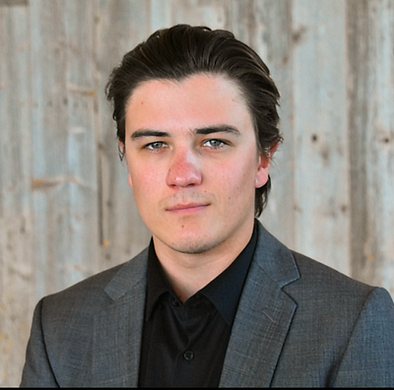
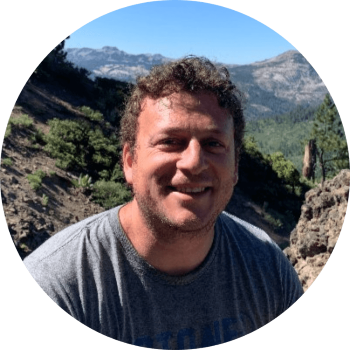 “It’s Invest Nova Scotia that has been the main supporter of Lillianah, and they’re really the reason we are in Nova Scotia,” Benjamin Slotnick (photo at right), founder and CEO of Lillianah Technologies, said in an interview with Research Money.
“We view Canada as front and centre and core to our long-term growth aspirations, and Atlantic Canada in particular,” he said.
The company has identified at least a half-dozen projects in Nova Scotia that would be suitable for its technology, plus a dozen more in Prince Edward Island, Slotnick said.
Lillianah Technologies is incorporated in Delaware and headquartered in Texas, but has done nearly all of its field research and testing in Cape Breton since 2024.
Incorporating as a “Delaware C Corporation” makes it easier to make modifications to corporate structure and offers more venture capital opportunities than incorporating in U.S. states or Canadian provinces, Slotnick explained.
Lillianah Technologies is testing its technology in Nova Scotia’s Bras d’Or Lake, which is actually an estuary where freshwater mixes with salt water Atlantic Ocean. The estuary is by the port of Iona near the village of St. Peter’s.
Lillianah Technologies Nova Scotia, a wholly owned subsidiary of the Texas parent firm, was part of Invest Nova Scota’s Ocean Technology pilot program in 2023.
“One of the best ways that they've really actually helped us is introducing us to local stakeholders and groups, which has ultimately culminated in the work that we're doing now,” Slotnick said.
Through Invest Nova Scotia, the company made contact with Cape Breton University and Central Cape Breton Community Ventures, a group based in Iona where Lillianah rents its workshop and lab facilities.
“Often those connections are just as important as the funding,” Slotnick said. “They’ve been incredibly helpful.”
Lillianah Technologies also has received financial investment through a combination of venture capital, family offices, philanthropy and some government support. The main venture capital investor is San Francisco-headquartered SOSVIndie Bio.
The large family office that invested was Lorentzen Investments, based in Chicago. And the philanthropy support came through the AirMiners Kiloton Fund, an early-stage investment vehicle designed to accelerate innovative carbon dioxide removal startups.
Slotnick said Lillianah’s technology isn’t yet commercially deployed, but the company is getting close to doing so.
“We are in the final stages for licensing the IP because we do have patents that are allowed now,” he said. “From a commercial perspective, we're doing another round of research in Nova Scotia before we move forward at that stage.”
“But we do have proof of technical efficacy that the technology works, and it not only works, it's actually more efficient than we originally thought it would be,” Slotnick said.
Technology has multiple applications across wastewater and organic waste streams
Across municipal, agricultural and industrial systems, wastewater and organic waste streams are becoming increasingly difficult and expensive to manage.
Excess nutrients and decaying organic material contribute to poor water quality, harmful algal blooms, oxygen-depleted “dead zones,” and greenhouse gas emissions that damage ecosystems and surrounding environments.
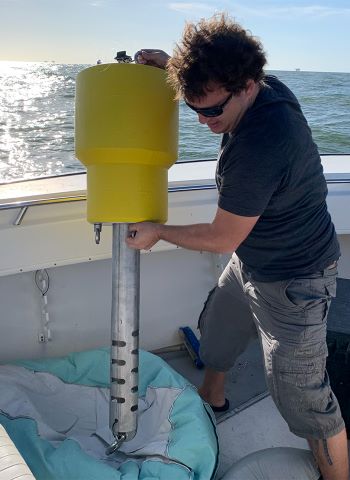
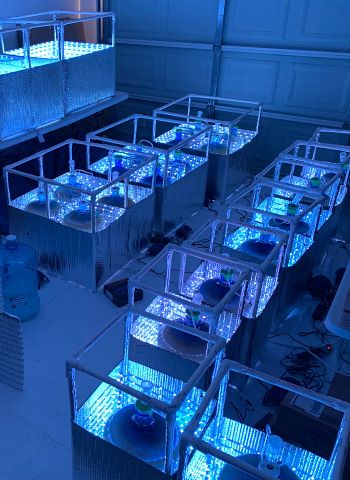 Lillianah’s biological treatment technology involves collecting (photo at left), cultivating in photobioreactors (photo at right), and then deploying microscopic-sized organisms, called diatoms.
Diatoms are a vital component of marine ecosystems. They are a primary producer in the food web, serving as a foundational source of energy and nutrition for various marine organisms.
Diatoms also help remove nutrients, organic material and other compounds that affect water quality in acidic waters and water bodies with excess nutrients.
 “Rather than replacing existing infrastructure, our tech is designed to work alongside it, whether it's in wastewater treatment facilities or industrial processing operations or agricultural watersheds, aquaculture environments, even downstream waterways,” Slotnick noted.
The goal is to improve water-treatment performance, reduce environmental impacts and help organizations meet increasingly stringent water quality requirements in a more cost-effective way, he said.
“What makes this platform of ours unique is our flexibility. We can tailor deployments to specific site conditions and integrate them with existing infrastructure,” he added.
“This allows us to address a wide range of water quality challenges without requiring large-scale construction projects or major facility expansions.”
That should appeal to investors, he said, because it’s a low-cost approach and enables large facilities to have their lifespan expanded without having to build a whole new facility, for a small fraction of the cost. “In many cases, we're helping clients get more performance out of infrastructure than they already have in place.”
Lillianah’s technology doesn’t introduce anything new to the environment, since the company uses locally sourced, native, robust species of diatoms (photo at right).
 “What we're doing is, we're bringing the system back to the way it would have been, or at least closer to the way it would have been had humans never been there,” Slotnick said. “So it's increasing and improving the conditions, not necessarily all the way, but at least in the right direction.”
Lillianah is testing its technology in Bras d’or Lake estuary because the almost landlocked estuary, fed by inlets from the Atlantic Ocean, provides the ideal physical conditions for controlled testing, he said.
Also, there are wastewater facilities on Bras d’or Lake and leaking residential septic tanks that are increasing the nitrogen and phosphorus concentrations in the estuary. “So we can go and work in that type of area and show meaningful progress and benefit,” Slotnick said.
However, Lillianah’s technology will work in natural bays, deltas and ports, as well as in any facility that’s processing organic waste, including municipal wastewater treatment plants, food processing facilities, paper mills and other facilities, he said.
“Our technology would work pretty much where you have downstream agricultural runoff or upstream waste of any kinds, where, depending on what composition of contaminants and excess nutrients are in the water, we just need to know what those components are and then we tailor our solution to that,” Slotnick said.
Getting to commercialization is a challenge in Canada
When it comes to challenges, Slotnick, who worked for about 10 years in the oil and gas industry before starting Lillianah Technologies, said the biggest challenge has been ensuring safety while doing fieldwork in deep-water, remote conditions with unpredictable weather.
“Nowhere [with those conditions] is it easy to do that, coupled with building our lab facility and just making sure everything’s functioning as it should.”
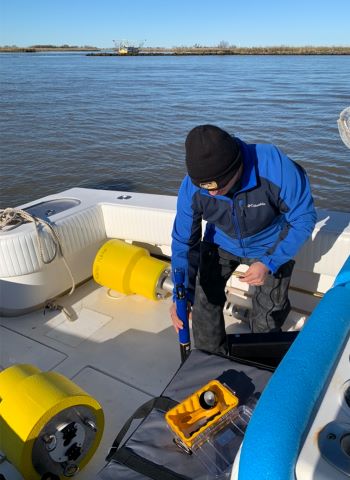
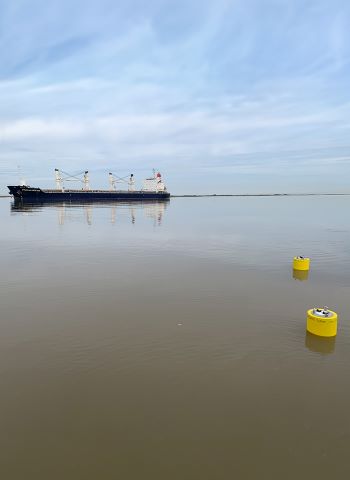 Last year, Lillianah partnered for its field trials with local lobster boat captains and put a lot of its treatment materials on the lobster boats (photo at right).
Getting to commercialization is also a challenge, because of the cost and fact that startups don’t have sufficient working capital or any revenue to secure loans.
“So what I would highlight is the moving from research and development, along with pilot scale activities to widespread adoption. That's that capital intensity I'm talking about. Any help with that – it's also time consuming [to raise funding] is what governments can really help with,” Slotnick said.
Beyond funding, government can act as a “convenor,” like what Invest Nova Scotia did in connecting Lillianah to key individuals and organizations in Cape Breton, he said. “That’s what enabled us to progress and get to the point where at today in Cape Breton.”
Also, any government policies that help encourage R&D and innovation are helpful, he said.
The United States historically had such policies, but they’re being cut back under the Trump administration.
“So this, strategically would be a great time for Canada to adopt a lot of what's worked for the United States for so many decades,” Slotnick said.
“Those types of investments led to generational wealth and benefit to society. And those types of government agencies, if Canada really does it the right way, I think could have that same type of success, not just in one sector, but in multi-sectors and just thinking big.”
It would also help for governments to be first procurers of technologies, providing the government procurement process can move quickly so as to not deter investment, he said.
As for his greatest satisfaction, Slotnick said it’s that Lillianah Technologies has made it this far and is “showing that the technology efficacy is there and that the technology really does work . . . That success, to me, is the best part of this.”
In addition to potential projects in Atlantic Canada, he said Lillianah’s technology has application at the mouth of the St. Lawrence Seaway where it touches the Atlantic, in the Great Lakes, and on the West Coast in British Columbia.
“We never see leaving Canada. It’s one of the reasons we set up the subsidiary there,” Slotnick said. “We just view [Canada] as core and near and dear to really how we want to operate long-term.”
Slotnick, who named his company Lillianah after his two daughters, Lillian and Hannah, said: “The company really stands for our kids and our kids’ kids, because we want to leave the world a better place for generations to come.”
R$
| Organizations: | |
| People: | |
| Topics: |



Events For Leaders in
Science, Tech, Innovation, and Policy
Discuss and learn from those in the know at our virtual and in-person events.
See Upcoming Events
You have 0 free articles remaining.
Don't miss out - start your free trial today.
Start your FREE trial Already a member? Log in
By using this website, you agree to our use of cookies. We use cookies to provide you with a great experience and to help our website run effectively in accordance with our Privacy Policy and Terms of Service.