
Canada’s fragmented, disconnected public health care system faces barriers in building a multidisciplinary workforce

Canada has a disconnect between skills, talent availability and technology adoption, and lacks the institutional structures to build a multidisciplinary health care workforce, industry and network leaders said at Research Money’s 25th annual conference in Ottawa.
Also, existing institutions, organizations and professions are resistant to change, preferring to stick with the status quo in a health care system lacks bold leadership and accountability, they said at the conference, Acting on Health: Reimagining Canada’s Promise.
 “What we are not seeing is bold, courageous leadership and political will to do the right thing for the taxpayers and our patients,” said Dr. Valerie Grdisa (photo at right), CEO of the Canadian Nurses Association.
“I felt I was empowered in the 1990s and early 2000s,” said Grdisa, who has worked as a CEO, an Alberta assistant deputy minister, and a vice-president of an Ontario research institute.
“And I don't know what's happened in the last 15 years, but I actually feel . . . the clamping down that's happened in terms of people innovating and actually being able to state what is really going on,” she said.
Canada’s health care system is still stuck in a 1980s infrastructure, architecture and care system design, Grdisa said. “We don’t like change. We love status quo.”
Clinicians who move into leadership roles don’t have the power and the direction, and there’s no accountability for choices that are made, she said. “We are in a no-accountability market on health systems.”
 Karine Morin (photo at right), president and CEO of the Federation for the Humanities and Social Sciences, said the organization has a new strategic plan and wants to promote humanities and social sciences scholarship and leadership, through advocacy, capacity building and knowledge exchange.
However, for the first time in its 94-year history, the Federation isn’t holding its annual Congress of the Humanities and Social Sciences – the largest academic convening event in Canada.
The humanities and social sciences community in Canada “really feels, generally speaking, a little bit undervalued, underappreciated, looking south [at changes in the U.S.] and being very scared, and perhaps not quite stepping up to the plate as is necessary right now,” Morin said.
The Trump administration has cancelled over $100 million in humanities grants that had already been distributed to scholars, writers and research groups through the National Endowment for the Humanities. In its budget proposals, the administration has consistently sought to wind down or entirely eliminate the budgets for the National Endowment for the Humanities and the National Endowment for the Arts.
In Canada, federal funding agencies invest in research at universities, while provincial government officials are focused on enrollment of students, graduate rates and placing students into the workforce, Morin said. “So right there, we have very different purposes at the two different government levels.
The three federal Tri-Council agencies’ research mission lacks a specific purpose to improve Canadians’ social wellbeing or influence policy, she said. “There are accountabilities and there are rigidities, and that whole pot of money can’t just be blended for a whole lot of interdisciplinary research.”
Postsecondary institutions are underfunded and competing among themselves and within themselves for students and funding, she added.
“So where are the incentives to develop a multidisciplinary, collaborative workforce?” Morin said.
“It's not at the provincial level in terms of how they frame education and how they let universities be somewhat self-governing,” she said. “It's not at the level of federal funding. So who's calling for it?”
Developing a multidisciplinary workforce isn’t built into the current culture, Morin said. “If we want the humanities, social science students to be sitting alongside health science students or STEM students, it's going to be hard work.”
Lack of skilled talent is slowing domestic biomanufacturing
 It is one thing to acquire funding and build new facilities, but “being able to operationalize these facilities, being able to meet the strict regulatory requirements, meet the technology burdens, adapt to innovations in these novel therapies, that's the real challenging part,” said Eric Lee (photo at right), general manager of the Biotherapeutics Manufacturing Centre at The Ottawa Hospital Research Institute.
A recent BioTalent Canada survey found that the life sciences sector will need to add about 65,000 new workers by 2029, he noted.
The University of Ottawa, affiliated with the Ottawa Hospital Research Institute, is undertaking a $70-million investment to build the Advanced Medical Research Centre in Ottawa as an innovation hub and business incubator designed to translate medical research into real-world patient care and biotechnology startups.
However, with the shortage of skilled talent, “the reality is that there will be an underutilization of capacity” in domestic biomanufacturing, Lee said.
“There will be a slower adoption of Industry 4.0, which I believe our industry is already quite behind, and probably a reliance on legacy systems, which have been in use for many decades now,” he said.
The Ottawa Hospital Research Institute, in partnership with BioCanRx, Mitacs and CASTL (Canadian Alliance for Skills and Training in Life Sciences), established a program that offers hands-on training to enable students coming out of universities and colleges to experience what life in biomanufacturing is and expose them to various career paths.
That program has trained about 60 trainees to date, “but that’s nowhere close to, of course, the 65,000 [new workers] needed,” Lee said.
Training people in Canada’s health care sector is “a little bit hodgepodge” across different areas, and a new model is required, he said. An industry partnership model would be ideal, he added, “but not just to collaborate on projects and work, but also to exchange skills, mentorship programs [and] coaching.”
Morin said health care practitioners receive mainly scientific training, “and we develop a health care system that is truly technologically driven.”
“And I think we lose sight of an important dimension, and are misaligned in terms of what we are supplying in terms of health care and what is the demand for the better care,” she said. “I don't think we have really yet [thought] about the patient at the center of this sufficiently.”
The demand for care, especially for wellness and preventative care, is community- and population based, and encompasses the entire spectrum from birth and reproductive care to death and palliative care, Morin noted
“All of this is deeply informed by disciplines of humanities and social sciences,” she said.
Health care professionals need to be trained much more in a collaborative, multidisciplinary way, with more emphasis on cultural studies and ethics and religion, Morin said. “They need not only to read the medical textbook, but some novels as well, to develop their interpretive skills – the emotional skills, the psychological skills that will treat the whole patient.”
Public health care system is fragmented and disconnected
Grdisa said Canada is “so focused on our federated models that it’s getting in the way of the patient safety, quality and impact in the R&D world and actually achieving [better outcomes].”
Across Canada, there are some 700 different corporate entities running the health care system, all with different boards, she said. “That’s problematic.”
For example, the Canadian Nurses Association is working with the Canadian Institute for Health Information and Canada Health Infoway on data infrastructure and AI models, but there’s no data for the models about nursing interventions, she noted.
“I think that what we're afraid of is that, because we're not at the [discussion] tables, we're not actually defining the data governance structures, we're seeing limited data going into the AI data models, and interpretation of what nursing is,” Grdisa said.
“We actually do need to understand each other better and try to collaborate,” she said.
Nurses want to have better partnerships and collaboration, but right now in Canada, 40 percent of all nurses leave the profession before they’re 35 years old, she noted.
The psychological safety of nurses is a huge issue in the health care system, “and the violence is out of control,” she added. “That’s one of the things driving people out of the workforce.”
At the same time, Grdisa said, internationally educated health professionals are emigrating to Canada, “and they can’t get employed.”
“There’s a ton of racism in our health system,” she said. “[Racism exists] within and between professionals, patients to professionals, professionals to patients, and that's actually a very huge inefficiency and it's causing burnout.”
Canada is now spending nearly $400 billion a year – or 12.7 percent of Canada’s GDP – on the public health care system, yet Canadians don’t know what the attrition level of health care workers is in regional hospitals or what the workplace satisfaction scores are, Grdisa pointed out. “And these are the things that we need to demand as taxpayers.”
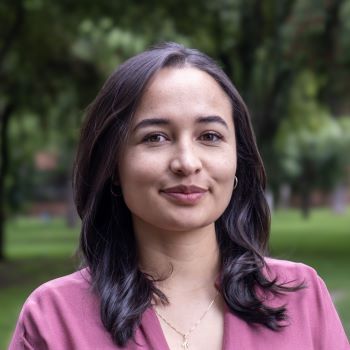 Panel moderator Dayana Tellez (photo at right), senior research and evaluation associate at the Future Skills Centre (FSC), said the FSC has for the past seven years invested in more than 450 projects with more than 2,000 partners committed to solving Canada’s most pressing labour challenges.
Those projects include how to receive internationally trained professionals in the health care sector, so they can smoothly enter the system and use their talent and skills.
Yet Canada still has a health care system “heavily bogged down by legacy operational realities, like our reliance on fax machines and fragmented records,” Tellez said.
Morin said that human dynamics should be at the forefront of improving the health care system.
“The choices will be made by individuals who will be deeply embedded in their lived experience, in their identities, in their communities, in their cultures. That’s why I'm making the pitch that the humanities and social sciences can bring that to the surface,” she said.
“So I do think that we have to expand even beyond what we've done so far and bring more of those perspectives to help us with some breakthroughs.”
R$


Events For Leaders in
Science, Tech, Innovation, and Policy
Discuss and learn from those in the know at our virtual and in-person events.
See Upcoming Events
You have 0 free articles remaining.
Don't miss out - start your free trial today.
Start your FREE trial Already a member? Log in
By using this website, you agree to our use of cookies. We use cookies to provide you with a great experience and to help our website run effectively in accordance with our Privacy Policy and Terms of Service.