
Ontario is the testbed for Canada’s “nuclear renaissance” – including who will pay for it

Editor’s note: This is the first in a series of Research Money stories that will examine the benefits and risks of Canada’s nuclear power expansion. Our stories will include the perspectives of both nuclear power proponents as well as those who think nuclear is not the option Canada needs.
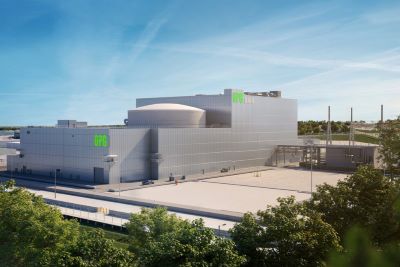 Ontario is the testbed for Canada’s ambitious nuclear power expansion – including who will pay for it and whether untested new small modular reactor technology (artist's rendering at right) will work, be affordable and be built on schedule.
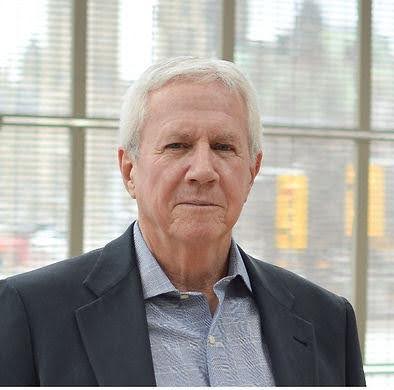
 The Ontario government’s push to build the world’s first small modular nuclear reactors (SMRs) as well as new large-scale nuclear power plants is being driven by several factors, says Ontario Energy Minister Stephen Lecce (photo at left).
Ontario’s projected power demand necessitates new supplies of reliable, clean power, he said during a webinar titled “Nuclear, Now: Is Canada ready for the new era of nuclear need?”
Nuclear power is, in the long run, the most efficient and affordable option for producing dependable baseload power, and building new nuclear reactors offers huge economic and job benefits and value to Canadian supply chains, he said.
“I just simply think if we are concerned about the sovereignty of where our materials come from, supply chains, the [longevity] of the assets and the industrial value to Canada . . . I just cannot imagine that any responsible government would not pursue this path,” Lecce said.
Ontario’s projected increase in power demand, according to the independent electricity system operator, ranges from 65 percent to 90 percent, he noted. That new power needs to be clean power to reduce carbon emissions and keep Ontario’s electricity grid “green,” he said.
“Fundamentally the problem we're trying to solve is we need reliable, clean power to energize the economy for the next 25 years,” Lecce said.
The question for Canadians, including Ontarians and all public policymakers, is what is the greatest return on investment in energy that’s in the national interest when it comes to supply chains, industrial benefits, workforce benefits, and reliable 24/7 baseload power, he said.
“Those are the criteria by which we evaluate our decisions. I think it's so obvious the future is nuclear,” he said.
Ontario’s nuclear expansion is based on a foundation of 50-percent of the province’s power already being generated by nuclear energy, Lecce said. “This has been a multi-partisan, a multi-generational reality for Canada for 50-plus, 60-plus years.”
“So the intention is to fix the problem of power [supply]. The strategy is to use disciplined builders and operators, be it through Ontario Power Generation or Bruce Power, to deliver the power to do it with an on-time, on-budget track record that is now becoming mainstream in this province and this country, which is unique in the world.”
Ontario’s planned four SMRs, plus refurbishment and expansion at the Bruce Power station (with a budget of $13 billion for the refurbishment), and refurbishment of four reactors at the Pickering station (budget of $26.8 billion), and a new nuclear reactor at the Wesleyville site (which could cost up to $165 billion) will add 29,000 megawatts of new clean, reliable power to the province’s electricity grid.
That’s $800 billion in economic advantage to our economy when we need this boost, it's 150,000 net new jobs,” Lecce said. “There's a cost to inaction and there's a cost to the triumph of ideology over pragmatism.”
Nuclear adds value to Canada’s supply chain
Building nuclear reactors is an economic stimulus that will use 93 percent to 95 percent of Canadian materials in the supply chain, Lecce pointed out.
Realizing this supply chain value is not the case with wind or solar energy, where 60 percent to 80 percent of the materials come from China, he added. “And I'm not in any means suggesting those are not important resources. I just simply want to have an intellectually honest discussion.”
“That’s why Premier [Doug Ford] has determined ultimately nuclear is going to be the driving impetus of our baseload [power’ expansion for 50 to 75 percent. But it will not preclude hydro or natural gas or for that matter renewables, [energy] storage, and likewise biomass and biogas. All of that is going to be really important as we build for the future.”
“I actually believe this [nuclear power] is the most affordable option for the people of Ontario and the numbers bear truth,” Lecce said.
The levelized cost of nuclear power is well below the alternatives of solar and wind, the energy sources compared by some in the public discourse, he noted. That is according to studies by the Ontario Energy Board (OEC) based on reliable 24/7, 365-days-a-year nuclear power, he added.
The OEB concluded that energy generated by nuclear power “is almost seven times more cost-effective than solar,” according to the Canadian Nuclear Association.
However, research by the Pembina Institute and the Ontario Clean Air Alliance concluded that the levelized costs of new nuclear power in Ontario would be two to three times more expensive than new wind or solar projects.
Ontario Power Generation’s first new SMR at the Darlington power station – which the government expects to be generating power by 2030 – is forecast to cost $7.7 billion, and all four new SMRs – amounting to 1,200 megawatts of new power – are projected to cost $20.9 billion.
For comparison, a recently completed 377-megawatt natural gas-fired power station in Saskatchewan cost $825 million.
But Lecce argued that if it’s agreed that Ontario will need 65 percent to 90 percent more power over the next 25 years, then “we're spending tens and tens of billions of dollars regardless, unless you want to have brownouts or look like Portugal or Spain in the winter.”
Ontario’s green economy, and more than 40 mines in northern Ontario under active expansion, will need baseload power, he said.
The lifecycle of nuclear power assets is about 80 years, including the refurbishment capacity, compared with a lifecycle of renewable energy assets of about 20 to 25 years, he noted. That means nuclear is a much lower-cost option for Ontario, he added.
In addition are the value-added benefits that nuclear brings to Canada’s supply chain and an estimated 150,000 permanent new jobs that Ontario’s nuclear expansion will provide, Lecce said.
“Small, medium and large enterprises are being fired up [across Ontario and Canada]” he said. “So for me, it is the obvious path. It doesn't mean we are blindly pursuing nuclear like some may argue the governments of the past were blindly pursuing renewables at all cost – 10 times above market. Not at all.”
The Ontario government’s energy plan is to “cadence” and “sequence” new energy supply procurements, including nuclear and other sources such as new hydroelectric power coming online in the mid- to late 2030s, Lecce said.
This allows – now and the future –the ability of government to rev up or pull back on the amount of megawatts they want to secure, he added. “On large scale nuclear it also gives us the ability to make a determination on the number of units we want to bring online.”
Ontario has shown it can complete large-scale nuclear projects on time and on budget
The global history of nuclear power has been plagued by cost overruns and projects either being completed behind schedule or, in some cases, abandoned altogether.
But Lecce pointed out that Ontario’s recent history with nuclear power shows the province can complete large-scale nuclear projects on time and on budget.
The decade-long refurbishment of the Darlington Nuclear Generation Station – the world’s largest nuclear refurbishment – was completed for $12.8 billion, finishing four months early and $110 million under budget.
“That is not done anywhere on Earth,” Lecce said. “And there's a reason why [it drew the attention of’ the French and the Brits and the Americans – fundamentally the inspiration of how to do it right.”
However, even nuclear proponents acknowledge that refurbishing an existing nuclear power plant is very different than building a brand-new large-scale nuclear reactor or building the world’s first unproven, commercial-scale SMRs connected to a utility grid.
But Lecce said that large-scale nuclear returns $1.30 to the value chain for every $1 invested.
If Ontarians and Canadians care about reducing carbon emissions, a clean environment, a stronger economy and workforce, and intellectual property, “this is why we pursued this [nuclear] path.”
The four SMRs that Ontario Power Generation is building at the Darlington Nuclear Power Station will, in fact, use U.S. and Japanese technology being developed by GE-Hitachi.
But Lecce noted that Ontario has secured an agreement that will see GE-Hitachi build a $70-million centre this fall that will service Ontario’s entire SMR fleet. Canadian teams will be trained to service and maintain the SMRs.
Also, the Ontario government secured a commitment from GE-Hitachi that a minimum 80 percent of Canadian materials will be used in each SMR at Darlington, he said.
Other provinces, including Saskatchewan, New Brunswick, Nova Scotia and Alberta, are considering deploying SMRs, and other countries are looking at both SMRs and new large-scale nuclear, he added.
Saskatchewan has created a new subsidiary, SAS Nuclear Inc., to lead regulatory business development for the potential development of nuclear power in the province.
Alberta recently launched public and industry consultations on using nuclear energy, with a report expected as early as this month.
The global market for SMRs is projected to be worth $150 billion to $300 billion by 2040, according to Natural Resources Canada.
Saskatchewan produces one-quarter of the world’s uranium supply, which is high-grade uranium produced by Cameco Corporation at its Cigar Lake and McArthur River mines and Key Lake mill, Lecce said.
Denison Mines Corp. has a Canadian Nuclear Safety Commission (CNSC) licence to build a new $600-million uranium mine and mill, known as the Wheeler Project, about 600 kilometres north of Saskatoon – expected to begin producing by mid-2028.
CNSC also held public hearings in February to consider a licence application from NexGen Energy Ltd. for its proposed $2.2-billion underground uranium mine and mill in northern Saskatchewan. A decision on the application is expected by June.
Coupled with Ontario taking the lead on new SMR and large-scale nuclear power, “it's a really beautiful made-in-Canada industrial success story,” Lecce said.
The federal government has a goal of tripling nuclear power in Canada within the next 20 years.
The federal government has invested more than $2.97 billion in new nuclear power in Ontario, including $2 billion for SMR construction and a $970-milllion commitment from the Canada Infrastructure Bank. The Ontario government has invested $1 billion in the SMRs at Darlington.
Lecce said the federal government needs to continue to invest, such as through the Canada Growth Fund and Export Development Canada to incentivize foreign adoption of Canadian nuclear technology.
“You’re going to see a lot more investment and more success stories when it comes to the industrial benefits of nuclear power in Ontario,” he said.
This webinar was presented by The Globe and Mail and sponsored entirely by nuclear power proponents, including presenting sponsor Ontario Power Generation along with CANDU, Westinghouse, the Canadian Nuclear Association, Akon Nuclear, and WSP Global Inc.
R$



Events For Leaders in
Science, Tech, Innovation, and Policy
Discuss and learn from those in the know at our virtual and in-person events.
See Upcoming Events
You have 0 free articles remaining.
Don't miss out - start your free trial today.
Start your FREE trial Already a member? Log in
By using this website, you agree to our use of cookies. We use cookies to provide you with a great experience and to help our website run effectively in accordance with our Privacy Policy and Terms of Service.