
New financing models required to attract private sector capital to support Ontario’s nuclear power expansion

Editor’s note: This is the second story in a series of Research Money stories that will examine the benefits and risks of Canada’s nuclear power expansion. The first story was published on March 18. Our stories will include the perspectives of both nuclear power proponents as well as those who think nuclear is not the option Canada needs.
New financing models to attract private sector capital – along with building a well-trained workforce – will be critical to Ontario’s nuclear power expansion, say investors and industry leaders.
Foreign investment will be required because domestic investment, including funding from Canadian governments, won’t be sufficient given the cost of new nuclear reactors, they said during a webinar titled, “Nuclear, Now: Is Canada ready for the new era of nuclear need?”
Ontario’s planned four small modular reactors (SMRs) are projected to cost $21 billion, while proposed new large-scale reactors will cost more than $100 billion.
 “We have to recognize that today these projects carry a lot of risks,” said Patrick Chabot (photo at right), manager and director of projects and cleantech at Canada Growth Fund Investment Management.
These risks include regulatory uncertainty, construction costs and uncertain timing of the projects, he said.
“There is definitely an aspect of technology risk, there's an aspect of permitting and environmental assessments that need to be overcome prior to people putting capital behind [these projects,” Chabot said.
Ontario Power Generation, which is building the SMRs at the existing Darlington Nuclear Generation Station, was unable to attract private capital to the project because the return on investment is potentially too low and the risks are too high, he said.
The federally funded Canada Growth Fund stepped in and committed $2 billion as “bridge funding” to help derisk SMR construction while acquiring a 15-percent equity stake in the project.
“We are effectively acting as concessionary funding. We taking more risk than private sector would otherwise, albeit we will realize a positive return on this investment,” Chabot said.
The federally funded Business Infrastructure Bank also committed $1 billion toward the SMR project. The Ontario government committed an additional $1 billion.
To attract private capital, government is going to have to guarantee to the private sector that if they make the investment in new nuclear projects, subsequent governments won’t change their policy and decide not to pursue nuclear, he said.
Or if government in the future does change its policy, it has to ensue the private sector is not worse off for having supported new nuclear projects at an early stage “where permitting is not done, environmental assessments are not done, consultation with First Nations is still ongoing and whatnot,” Chabot said.
 Sashen Guneratna (photo at right), managing director, investments, at the Canada Infrastructure Bank, said he believes there is an opportunity to bring in private capital to support new nuclear projects.
“The onus is on the financial community to come up with models that attract a lot of private capital into these transactions and also take some risk – not all risk, because the government has shown that they're willing to take the risk – but getting private capital in to set up to invest is going to be absolutely critical,” he said.
Twenty years ago, when Bruce Power did its first nuclear reactor refurbishment, Guneratna said he was involved with the financing. Out of 30-plus institutions approached for financing, only four institutions were willing to invest.
But today, Bruce Power has got “a tremendous bank group, tremendous bond issuance platform” that is attracting new banks every year to participate, he said.
The successful refurbishments at the Darlington and Bruce Power nuclear power plants become “bankable and financeable” because there’s a track record “and you’ve got the engineers telling the lenders, ‘Look, it’s been done and can be done at the right price and at the right schedule,’” he said.
However, new nuclear reactors, including the SMRs and new large-scale reactors, will be more challenging, Guneratna noted. “I think the first couple will be more risky and we will be more challenged getting private money in.”
There are new financing approaches and tools that could be used to derisk these early projects, he added. These could include government financing backstops, or having ratepayers assume some of the liability up to a certain point and then the private sector makes a return on its investment within a specific range of financing if certain milestones are met.
“But ultimately I think you'll see once the first couple of [reactor] units are built, there will be lots of money chasing these projects,” Guneratna said.
New financing model used in the U.K. is derisking the cost of investment
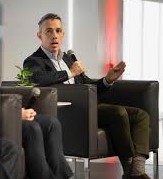 Given that the successful refurbishments of the Darlington and Bruce Power nuclear power plants have established a track record, “credit capital markets will be looking through those projects as if they're fully executable, they'll have a budget, they're going to get done on time,” agreed David Manii (photo at left), managing director, corporate banking, at TD Securities.
Likewise, building the first couple of SMRs at the Darlington site on time and on budget – and backed by concessionary capital through the Canada Growth Fund and Canada Infrastructure Bank – will demonstrate a track record to the commercial capital markets, he said.
“Nothing would make me happier than to have a broad-based financing ecosystem for SMRs a you move forward,” he said.
The challenge will be not only finding the right financing structures and risk allocations that bring in private capital effectively, but also sharing the enormous amount of capital required, which will stretch bank markets, debt markets and equity markets. Manii said.
There is a huge capital market in North America for mega-project financings, for projects such as liquified natural gas and offshore wind energy, he noted. “I think it will be building that track record in the nuclear space that unlocks private capital in a big way.”
Ideally, the financing for a new nuclear project will include an offtake agreement or some type of rate-based return model on the underlying project, along with a construction company that can ultimately backstop the deployment of the project, Manii said.
In some rate-based models, any cost overruns on the project are added to ratepayers’ bills, providing revenue to pay back the private capital investors, he said. “It derisks the capital investors, but it’s certainly not great for the ratepayer in certain instances.”
Guneratna pointed to a financing model in the U.K. that attracted Caisse de dépôt et placement du Québec, Quebec’s largest pension fund manager, to invest up to £1.7 billion (Cdn$3.2 billion CAD) to acquire a 20-percent stake in the Sizewell C nuclear power plant project in Suffolk.
This investment, announced in July 2025, makes the Caisse the second-largest investor behind the U.K. government, supporting the construction of the 3.2-gigawatt power station.
The U.K. government and regulator created a protective framework for private sector investors, which Guneratna described a “laddered approach.”
The U.K.’s regulated-asset-base model pays companies during the construction phase, reducing their development risk and allowing them to secure cheaper financing.
The framework protects the Caisse’s return on investment – within a range for potential return – in the event of cost overruns or significant delays.
This approach creates an alignment of risk and return between the private sector and the public sector in attracting some of the large investors, Guneratna said.
If Canada we can come up with similar financing framework, “you would get lots of interest from the private sector and that would create the environment and give us the runway to get some of the Maple Eight (the largest eight Canadia pension funds) who have billions of dollars to invest, so that you get certainty on that funding,” Guneratna said.
Nuclear projects will require raising rates for electricity ratepayers
Guneratna said there is a lot of private capital available in Canada for projects such as electricity transmission, energy storage and renewable energy generation that’s less complex than nuclear power, costs less money and is built to tight timeframes.
“But when you think about nuclear, especially new builds, everything's out the window, everything's complicated,” he said. “We need to make sure we have all the right people around the table who can get it built on time, on budget, and take some of the risk.”
“And I'm not here to say the private sector should take all the risks because that's not possible,” he added. “But at the same time, we should look to optimize the models we're using to get these assets built,” to take some pressure of ratepayers and taxpayers.
One challenge with long-lived nuclear power assets is “we're trying to make 50-year decisions on four-year political terms,” Guneratna said.
If international investors are worried that the nuclear power projects will get stalled or cancelled by the next government, that impedes the ability to raise effective and efficient capital, he said.
Yet Manii pointed out that when it comes to capital required to build new large-scale nuclear power plants, the “depth of just Canadian capital markets alone certainly wouldn’t cut it.”
“I think particularly on some of these bigger transactions, foreign capital will be fairly critical to the entire process,” he said.
But, he added, as Ontario builds a track record of doing new nuclear reactors on time and on budget, “there’ll be demand and appetite for it, without a doubt.”
Ontario’s residential electricity rates increased 29 percent last November, driven in part by rising nuclear generation costs, including from a refurbished reactor at Darlington that returned to service five months earlier than expected. The government increased the Ontario Electricity Rebate to 23.5 percent to help mitigate the direct impact.
Ontario Power Generation (OPG) recently filed a rate application before the Ontario Energy Board seeking roughly a doubling of the payments OPG receives for the electricity generated by its nuclear power plants.
Rates could potentially increase from $111.61 per megawatt-hour (MWh) in 2025 to $207 per MWh in 2027.
OPG’s rate application “really confirms that these projects are among the most expensive ways to meet our need for electricity,” according to the Ontario Clean Air Alliance. “We could expand solar, wind and storage at a fraction of the cost and avoid seeing our power bills go through the roof.”
 OPG’s regulatory rate filing sets out approximately $30 billion of investment required to keep Ontario’s nuclear refurbishments and new nuclear power projects going, while keeping rate impact increases to 2.4 percent per year over the next five years for residential customers, said Kim Lauritsen (photo at right), senior vice-president of enterprise, strategy and growth at OPG.
The Ontario Energy Board process is very transparent, she noted. “So I think not just delivering our projects on time and on budget, but being transparent through the process of how we're spending that money will be very important to maintain public confidence and support.”
Ensuring skilled workforce of sufficient size will be crucial
In addition to attracting private capital to help pay for Ontario’s nuclear expansion, the province – and other provinces considering new nuclear – will need to ensure Canada has a skilled workforce of sufficient size to build all the new reactors.
 Growing that workforce has already started with the completed refurbishment at the Darlington nuclear power plant, and ongoing refurbishment at Bruce Power plants, said Scott Ryan (photo at right), senior vice-president of nuclear operations at Aecon Nuclear.
These projects have built up a substantial skilled workforce and experienced project management teams, he said. “We’ve built out full training centres to make sure that we’ve got the capacity to do this.”
Three of the largest nuclear refurbishment projects in North America are happening in Ontario, which has developed the workforce teams to deliver on the projects, he noted.
The lessons learned and technologies developed in one project are applied to the next project, Ryan added. This includes the use of robotics and automation to remove personnel from high-hazard environments.
“The tooling and things that go into this are incredibly complex and now we’ve got them figured out, and they worked so well and we proved that they worked well at Darlington, we can carry them onto future projects so that we're in a better position,” he said.
“They're tied to the schedule, they’re resource-loaded, so we know exactly what we need and when we need it,” Ryan said.
Ontario’s nuclear expansion will require adding thousands of people to the skilled workforce, so there needs to be funding in place for skilled trades and unions to “to make sure that we’ve got people coming through that are wanting to get into nuclear and are trained to do so,” he said.
“My number one message is, ‘Let’s not stop,’” he said. “We’ve got great momentum. We've delivered the first project early [and] under budget. We've got multiple more projects that are now in execution. We can't stop what we’re doing.”
Ryan said that if for some reason there are decisions to pull back on the projects or funding, that will stop the continuity in the projects, limit the industry’s ability to move workforce teams among projects to leverage the knowledge gained, and disrupt the supply chain.
“We've got technology providers that have built their business here in Canada based on decades of future work worth billions and billions of dollars,” he said. “We need that to keep continuing in the cadence that it's on right now.”
Lauritsen said that having the lessons learned from constructing the G7’s first small modular nuclear reactors will be extremely valuable in helping other jurisdictions.
“As an industry, we plan to succeed or fail together and we plan to succeed,” she said. “It’s in our interest to help other jurisdictions to succeed as well, because the stronger the industry is and the stronger the supply chain is, we will benefit from that in Ontario as well.”
 The momentum that Canada’s nuclear industry has now needs to be enabled, said George Christidis (photo at right), president and CEO of the Canadian Nuclear Association.
That enablement will require cooperation and coordination between federal and provincial governments, he said.
Christidis said government has to deliver certain things around nuclear financing (including promised investment tax credits), reduce regulatory duplication, and support growing the workforce and developing the supply chain “to take advantage of the opportunity that we have as a country, to leverage this industry that does apply across Canada but also abroad.”
This webinar was presented by The Globe and Mail and sponsored entirely by nuclear power proponents, including presenting sponsor Ontario Power Generation along with CANDU, Westinghouse, the Canadian Nuclear Association, Akon Nuclear, and WSP Global Inc.
R$




Events For Leaders in
Science, Tech, Innovation, and Policy
Discuss and learn from those in the know at our virtual and in-person events.
See Upcoming Events
You have 0 free articles remaining.
Don't miss out - start your free trial today.
Start your FREE trial Already a member? Log in
By using this website, you agree to our use of cookies. We use cookies to provide you with a great experience and to help our website run effectively in accordance with our Privacy Policy and Terms of Service.