Managing income disparity and playing to strengths to build the global companies Canada needs

 Jeffrey Crelinsten is CEO of Research Money Inc. and publisher of Research Money. He is also president and CEO of The Impact Group.
OPINION & ANALYSIS
Burke Brown was an investment banker who was deeply interested in psychology and human economic behaviour. He cared deeply about the need for young people to embrace science and technology, especially mathematics. I was lucky enough to meet him several years before he left this world in 2016 at the ripe age of 88.
During his successful 50-year business career, Burke came to be known as the “go-to person” for raising capital for smaller technology deals. He was a financial consultant to governments, innovators and inventors; and a founding director of the University of Toronto Innovations Foundation and the University of Waterloo’s Canadian Industrial Innovation Centre. But to me, his lasting legacy was his search for a law of human economic behaviour.
Income disparity bedevils policymakers, economists, social activists and politicians alike. It’s one of the most common issues dividing the left and right of the political spectrum.
The left highlights the troubling fact that most of the country’s wealth resides with a minuscule number of individuals compared to the rest of us. They press for higher taxation of the wealthy and vilify them for not paying their fair share.
The right argues that higher taxation will drive successful entrepreneurs out of the country, taking with them the fruits of their success, including corporate and personal tax revenue, jobs and corporate philanthropy. Many create clever tax avoidance schemes with their lawyers.
For Canada, which is trying to build a resilient economy and quality of life for its citizens, income disparity poses a real conundrum.
What if I told you that income disparity is inevitable, that it’s a law of nature as fundamental as gravity. That’s exactly what Burke Brown discovered. He was able to use his discovery to analyze the secret of luck.
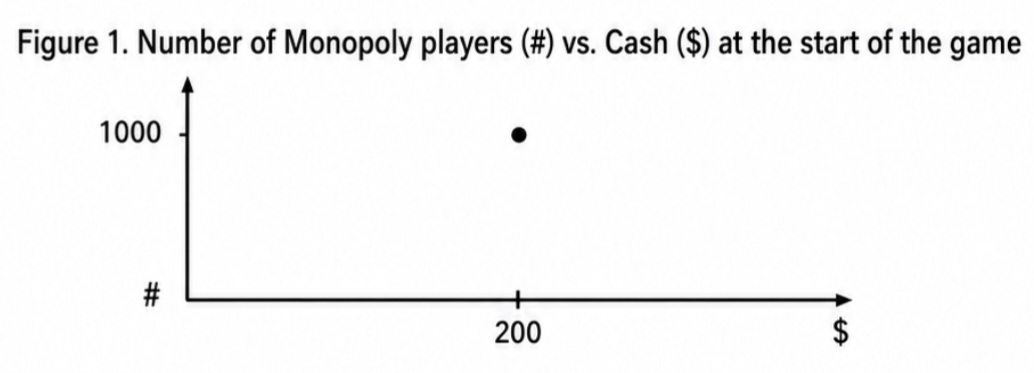
Imagine a Monopoly game with 1,000 players. Each starts with $200. Graphing the number of people (#) vs cash value of assets ($), you would get a point as shown in Figure 1. 1,000 people at $200.
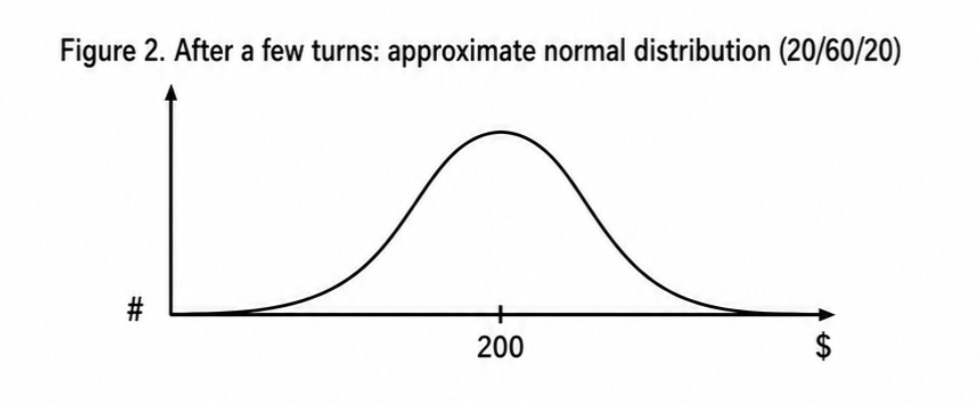
After a few turns around the board for all the players, some people would have more cash and property than others. Most people (about 60 percent) would lie somewhere in the middle, between those on the left end of the curve with much less cash and assets (about 20 percent) and those on the right with much more (about 20 percent). A graph would look like Figure 2. This 20/60/20 pattern is called the “normal distribution.”
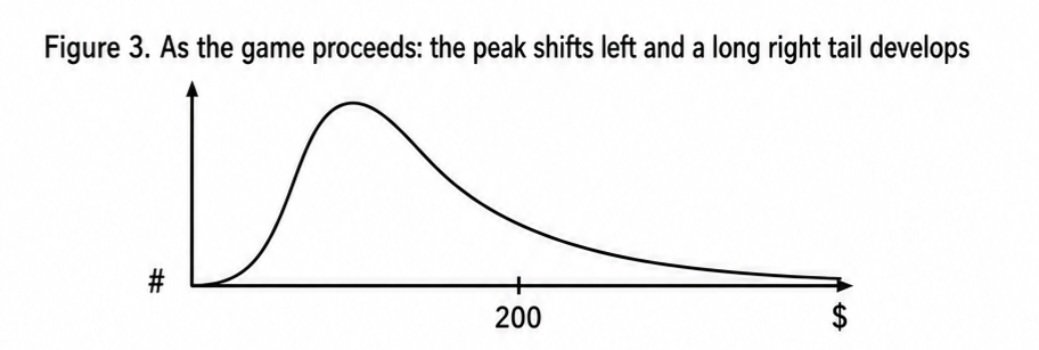
As the game proceeds, those with more assets have an advantage compared to those with less. They accumulate assets (e.g. build hotels on properties) and cash (collect rents) while those with less cash accumulate much less. Over time, the peak of the normal distribution curve moves higher and to the left as more people have fewer assets. A “long tail” develops at the right, where fewer people have more assets. (See Figure 3.)
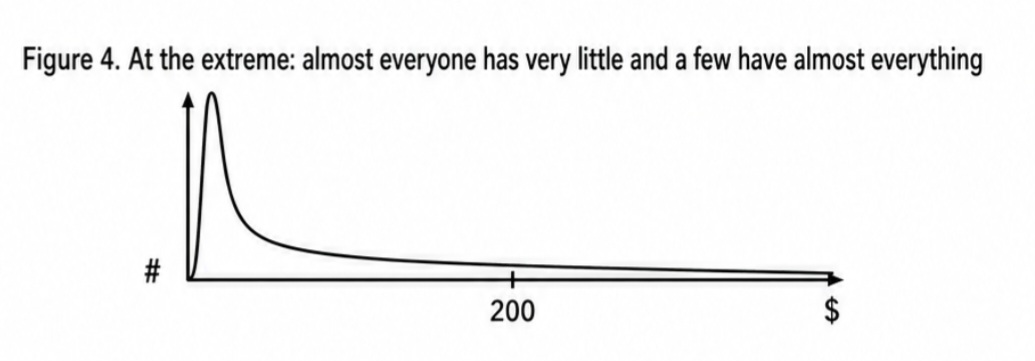
At the extreme, the peak of the curve crashes to the left, where almost everyone has hardly anything and a few have everything. (See Figure 4.)
Mitigating the negative consequences, and playing to your strengths
The inevitability of this evolution is what Burke wanted policy makers and the general public to understand – and accept. Then, instead of vilifying high earners and successful entrepreneurs, policies and behaviour could be developed to mitigate the negative consequences of this law of human economic behaviour.
Burke supported taxation policies that redistribute wealth from the top earners to the lower earners as one way to mitigate, although if such policies were carried to an extreme, he warned that it would defeat the purpose by driving high earners away along with the jobs they create and the wealth they generate.
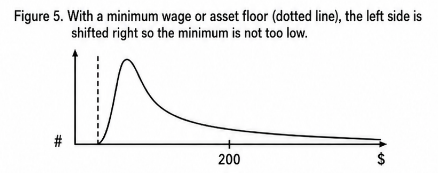
Burke wanted economists and policymakers to figure out ways to move the entire graph to the right so that at the left-hand side of the curve the cash amount isn’t too low. One way would be a minimum wage, which puts a floor on the asset value at the extreme left of the curve. (See Figure 5.)
More importantly, Burke showed how an understanding of this law holds a clue to the secret of luck and how to create good luck.
All human characteristics obey the normal distribution – height, weight, intelligence, sociability, specific abilities (e.g. athletic, artistic, mathematical, technical, musical), etc. For every one of these characteristics, there are people on the “left” or the “right” of the normal distribution. If you’re at the “right,” you can utilize your relative advantage to your benefit. For example, a very tall person has a better chance of excelling in basketball. A highly sociable person could be good in sales or be a community leader.
You can assemble these characteristics to your advantage. If you’re shy (on the “left” of the sociability distribution), don’t audition for the lead part in a film or play. Look for areas where your “right-side” trait can shine without being in the limelight. For example, if you’re above average in mathematics, you might excel as an accountant.
The secret to luck is to play to your relative strengths and accommodate your relative weaknesses. Socrates famously said: “Know thyself.” This is what he was talking about.
The same wisdom that applies to individuals applies to countries. Canada stands at the left of the productivity distribution (weak) but at the right of the research distribution (strong). Canada is above average in certain industrial sectors, e.g. health and life sciences, agriculture and energy.
Knowing this law of human economic behaviour and the inevitability of income disparity puts the lie to Canada’s elected officials’ tendency to “spread the peanut butter” in delivering support to companies. I’m fully aware of why they do it – to fight for their constituents – and I’m sympathetic.
However, if Canadians are to continue to enjoy prosperity and a good quality of life, our leaders need to resist creating so-called neutral programs that treat every region the same and rationalize it in the interests of fairness.
They need to swallow hard and target support to the sectors that are strong and have the potential to build large global enterprises here. In time, the prosperity they generate will spread to everyone.
R$
| Organizations: | |
| People: | |
| Topics: |




Events For Leaders in
Science, Tech, Innovation, and Policy
Discuss and learn from those in the know at our virtual and in-person events.
See Upcoming Events
You have 0 free articles remaining.
Don't miss out - start your free trial today.
Start your FREE trial Already a member? Log in
By using this website, you agree to our use of cookies. We use cookies to provide you with a great experience and to help our website run effectively in accordance with our Privacy Policy and Terms of Service.