
Leadership training coupled with technology development produces innovations for the energy industry

In the capital-intensive, safety-critical, highly regulated oil and gas industry, the innovator trying to solve a problem for a company and the firm often will drift apart.
Frequently, the innovator’s bright idea ends up not working for the company.
Avatar Innovations, a Calgary-based corporate venture studio, enables innovators to work closely on their solutions directly with the companies.
 “We try and really shorten that distance by working with the employees of the major industrial energy companies in Canada and in the U.S.,” Kevin Krausert (photo at right), CEO and co-founder of Avatar Innovations, said in an interview with Research Money.
“Through our programming, the employees of these companies who are subject matter experts in their particular domain will join a team and work through the problem definition, technology scouting and ideation, and actually build the solution,” he said.
Avatar Innovations is a venture platform purpose-built for the energy industry – developing both the innovative technologies and the leadership talent required to deploy these technologies.
Through a blend of experiential learning, industry collaboration and real-world commercialization pathways, Avatar helps energy companies solve their most pressing challenges while creating unique real-world, collaborative experiences and opportunities that better equip their people to lead.
Multi-billion dollar energy corporations have a very specific structure, defined capital allocations and strict risk protocols, Krausert noted.
It is difficult for out-of-the-box thinkers to work within that tightly structured environment, especially to take their innovations from ideation to commercialization and drive productivity.
“We give the large corporates the nimbleness of a startup,” he said. Companies can place their brightest people in Avatar to both develop their innovative technology and work on the leadership skills to bring it to fruition.
People participating in typical leadership development programs at a postsecondary or an executive education program usually don’t get a chance to “get their hands dirty” and work directly on a technology.
Also, developing new technologies, especially in the oil and gas industry is often “a solution in search of a problem” – something companies aren’t really looking for.
“Our view on that is if you do leadership development without technology development, it doesn't take people very long to look across the street and realize there's a better kit [the processes and technologies used in energy production],” Krausert said. Companies not investing in innovation will be outpaced by competitors that have a better or more innovative way of doing things.
“If you do technology development without leadership development, [corporate] culture will eat technology for breakfast every day of the week. They'll just unplug it,” he added.
“So in this world of exponential technology change, where the pace of technology change is happening faster than any of us can comprehend, what is actually needed is a new type of personal leadership that challenges oneself to be bigger and better in expanded world.”
Support for leadership and technology development, along with funding and scaling
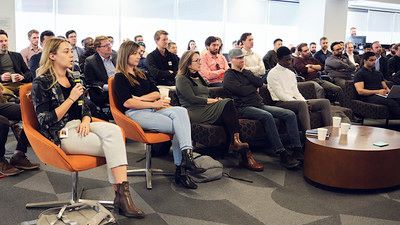 The Avatar program is a three-stage innovation ecosystem – Ignite (leadership development), Studio (technology development), and Avatar Ventures (funding and scaling). The program is designed for mid-career professionals who want to accelerate their skills, expand their network and work on real energy challenges – without stepping out of their current role.
The program runs part-time over 14 weeks with live sessions, team sprints and executive reviews. Full virtual participation is supported globally.
Tuition is $5,000 for independent applicants not covered by a partner organization or scholarship. Avatar can invoice employers directly so participants can use professional development budgets.
Krausert said Avatar works with about 80 percent of Canadian oil and gas producers, and about 40 percent of U.S. oil and gas producers – and works heavily on technologies to decarbonize the oil and gas industry.
Avatar also has several midstream and downstream partners in the oil and gas industry, as well as partnerships with ATCO, BC Hydro and others for electricity grid and wind, solar and hydro opportunities.
The focus is on innovations that are going to drive value inside the energy industry, now and in the near future.
“What we're giving people is a safe sandbox to try new things to be able to de-risk the technologies to the point that they get to a point that they're capable of being deployed,” Krausert said.
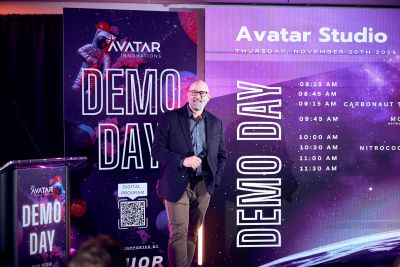 Mentors play a critical role in Avatar’s programming. Mentors are more senior individuals inside the energy industry whose main job is to keep the innovator on track and motivated, and also open doors to an experienced network and find out what technologies have worked or not in the past.
“Sometimes participants will hit a wall and they’ll be meeting with mentors three times a week. And then sometimes they’re running like crazy and they’ll meet with them once a month,” Krausert said.
Another differentiator with Avatar’s program is that, unlike innovative new technologies developed within a corporation, the innovator gets an equity share in the innovation’s intellectual property – often in the new company formed to deploy the technology.
Krausert said about 35 percent of Avatar participants’ ideas get to the development phase, where the company invests financially and starts doing some testing.
Of those, 30 percent to 40 percent of participants advance to having a corporate co-provider that provides capital for further development and move on to pilot the technology.
Many people believe that the oil and gas industry isn’t very innovative, that it essentially drills holes in the ground and extracts oil and gas.
But Krausert noted that the oil and gas industry is the largest investor in new clean technologies in Canada “by a country mile.”
The innovation and investment that was required to unlock Alberta’s oilsands deposits and turn bitumen into the world’s third-largest oil reserve “required some of the most advanced chemistry, process engineering and technology anywhere in the world,” he said.
Also, the oil and gas industry is the only heavy industry that’s come up with a model like Avatar “to empower its people in a radical new way to be able to drive productivity and innovation,” he said. The industry “is young, it is diverse, it is innovative, and it is inclusive.”
Program produces technologies that address real-world problems
Examples of Avatar’s success include a team that developed a technology that unplugs late-stage wells, without having to vent a lot of methane gas (a potent greenhouse gas) and other products into the atmosphere – thereby increasing production without having to drill a new well. This technology is currently being piloted in the field.
Another Avatar team took a carbon capture technology from the oil and gas industry and modularized it and put it on a craft-sized brewery.
Breweries typically make beer using fruit-grade carbon dioxide – which is becoming increasingly expensive – by carbonating the gas and reinjecting all that CO2 into the atmosphere.
But the Avatar team’s technology captures the CO2 and reinjects it during the beer-making process – creating net-zero beer. The technology is being piloted by a company called CO2 Brew.
CO2Brew last December was one of nine projects that received the Canadian Food Innovation Network’s Innovation Booster funding.
 Technical engineer Taban Sabih (photo at right), initially participated in Avatar Innovations because she was looking for professional development. But because also focuses on finding working solutions for the energy industry’s challenges, her team tackled a real-world problem.
“What I really liked about Avatar in particular was the emphasis on innovation, innovative thinking, looking at a problem and how to just think of a problem in a different, like a more practical way,” she said.
Her team did a lot of customer discovery, engaging with many people about everything related to electrical power reliability.
Some team members had experience with a longstanding problem: the failure of connection points – cable connections – in an electrical cable. More than 55 percent of failures occur at the connection point, Sabih noted. “So it truly is the weakest link and truly is like the single largest point of failure that currently does not have continuous monitoring.”
Utility companies will continuously monitor large assets, such as transformers, but not the network of cables and cable connections that may be checked only every few years or so.
A lot of the companies “are focused on transmission systems because those are high-cost assets. We're focusing specifically on distribution networks,” she said.
Her Avatar team developed a device to do continuous monitoring of power cables, for better proactive maintenance and system reliability.
With Canada planning to expand its national electricity grid by two or three times, “power reliability is a very big topic right now, especially when we talk about like electrification, grid enhancements, AI, all sorts of things,” Sabih said.
“And at the moment, we don't do continuous monitoring for our distribution networks. So we're looking to change that and provide both the hardware and the software to get that early fault indication” in power cables.
Sabih founded and is CEO of a startup, Splice N Connect, that’s developing a scanning device with predictive analytics and specialized tools to use the technology. “It’s like an all-in-one solution that just clamps over top [of the power cable],” she said. “So it’s non-invasive, it’s easy to install and easy to use.”
Also, unlike technologies for continuously monitoring large assets, Splice N Connect’s device doesn’t require the entire electrical system to be de-energized.
Sabih noted that by the time her team’s Avatar program had ended, her startup had already signed letters-of-interest with several potential customers. An oil and gas company has made a significant contribution toward getting the company’s technology commercialized and deployed.
Splice N Connect is on its second National Research Council-Industrial Research Assistance Program, and also received a significant grant from Alberta Innovates.
The Avatar Leadership Fund also led a pre-seed funding round earlier this year for Splice N Connect that raised $1.75 million.
“There have been a lot of things that have come out, all of them because of the Avatar program,” Sabih said.
The company, which now has three fulltime and one part-time employee, is planning its first field-installation pilot of its technology this October, with an Alberta municipal utility.
Although Splice N Connect is currently focused on one aspect of power reliability, “we are a power reliability company,” Sabih said. “So enabling data-driven decision-making, doing better proactive maintenance, that's our end goal. If there are other opportunities to grow what we're doing and other ways from a technology perspective, we can do that as well.”
R$
| Organizations: | |
| People: | |
| Topics: |
.jpg)



Events For Leaders in
Science, Tech, Innovation, and Policy
Discuss and learn from those in the know at our virtual and in-person events.
See Upcoming Events
You have 0 free articles remaining.
Don't miss out - start your free trial today.
Start your FREE trial Already a member? Log in
By using this website, you agree to our use of cookies. We use cookies to provide you with a great experience and to help our website run effectively in accordance with our Privacy Policy and Terms of Service.